

history
1885
the first scottish settlers arrive to present day marina jack
In 1885, a group of Scottish families set out for Florida with the promise of a new community waiting for them on the shores of Sarasota Bay. Their journey began aboard the Anchor Line steamship Furnessia, which carried them from Glasgow across the Atlantic to New York. From there, they continued south through Florida before finally arriving in Sarasota in late December.
What awaited them was not the community they had expected. The developed settlement, homes and cultivated land they expected were largely absent. Instead, they found an isolated stretch of Florida wilderness and the difficult task of building a community where very little infrastructure yet existed.
Some of the colonists returned north or left Sarasota altogether. Others remained, like the Macdonald Clan. Their brief and difficult experiment became part of the story of Sarasota's beginnings.
1958
the riverview high school kiltie band is established
A small group of students in Sarasota adopted the Dress MacDonald tartan, carrying forward the Scottish heritage woven into Sarasota’s history.
1960
58 kilties strong
1961
the kilties hit the road
First major trip: the Orange Bowl Parade
1993
cinema debut
The Kilties were filmed in a Christmas parade scene for the French movie "Seven Sundays."
2018
a new generation of kilts
After decades of wear, aging Kiltie uniforms were ready for renewal. Former Band Director Mark Spreen (Kiltie Class of 1978) spearheaded the ambitious undertaking, with his successor, Andrew Dubbert, and longtime Kiltie Band Booster Vince Vance (Kiltie Class of 1975) carrying the project through to completion.
A new generation began with 200 meters of MacDonald Dress Modern tartan, specially woven for the band by Lochcarron of Scotland in Selkirk, Scotland. The single batch ensures consistent colors and patterns as aging kilts are replaced over time. From there, the fabric traveled to Edinburgh, where each kilt was hand-sewn by ScotClans and signed by its maker. Click to learn more about the uniform →
2027
kilties travel to washington d.c. to march in the cherry blossom parade


from scotland
to sarasota

the pattern
Wool kilts were made for Scotland’s rugged landscape - naturally water-resistant, durable and flexible enough for movement across rough terrain. A kilt is not a skirt. It evolved from practical Highland dress built for an unforgiving environment. A kilt features a particular pattern, known as tartan.
Tartan became a powerful symbol of identity and belonging, with particular patterns -or setts- associated with clans and families. Its colors often draw meaning from Scotland itself: green for the land, blue for its waters, red for courage and battle, and white characteristic of formal dress tartans.
The Kilties complete their military-style uniform with the bright scarlet battle jacket, traditionally worn by Scottish regiments.
Green
the land
Blue
the water
Red
courage
White
formal
MacDonald Tartan
When Riverview adopted Scottish military dress in 1958, MacDonald Dress Modern was selected for the Kilties’ tartan, connecting the new band to the MacDonald clan heritage of some of Sarasota’s early Scottish settlers. Click to view the timeline →
A single Scottish clan can have several variations of its tartan, each with its own colors and character. Among the most common are Ancient, Modern, Weathered, Hunting, and Dress.
Dress tartans are traditionally associated with formal occasions, celebrations, and Highland dancing. They often incorporate more white into the original pattern, creating a brighter, more distinctive appearance while preserving the tartan's underlying design.
The MacDonald tartan has 36 variations. Here's a few of them:

MacDonald Ancient

MacDonald Dress Ancient

MacDonald Weathered

MacDonald Modern

MacDonald Dress Modern
the craftsmanship
Our tartan was woven and sewn into uniform elements with care in Scotland, honoring generations of traditional craftsmanship. Each uniform is a piece of Scottish heritage, made by hand and worn with pride by generations of Kilties.


a glance at the journey


SELKIRK, SCOTLAND
Lochcarron of Scotland weaves a 200-meter bolt of tartan specifically for the Kiltie Band. Producing the tartan as one continuous run ensures consistency in its colors and pattern.
EDINBURGH, SCOTLAND
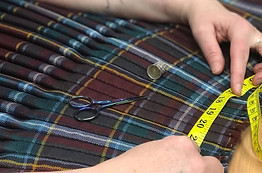
The tartan is sent to ScotClans, where skilled kiltmakers transform it into wearable pieces. Each kilt is individually cut, pleated and hand-sewn with meticulous attention to detail. Each kilt is then signed by its maker.
SARASOTA, FLORIDA
The finished uniform pieces make their way across the Atlantic to Riverview High School, worn proudly by a band of 200+ students.
did you know?
A single Kiltie uniform costs approximately $3,000. With more than 200 members, outfitting the entire band represents an investment of over $600,000! Jackets and kilts can take 8-12 months to make. Maintaining and replacing these handcrafted uniforms is no small undertaking.
Help us preserve this remarkable piece of Kiltie heritage for generations to come. Every contribution makes a difference.
